AI contact center solutions help organizations deliver faster, more consistent support while empowering agents to do their best work. When built on omnichannel contact center software, these platforms unify voice, chat, email, messaging apps, and social channels into a single interface. By combining automation, natural language processing, analytics, and intelligent routing, modern AI-driven contact centers can reduce wait times, improve first-contact resolution, and unlock new insights from every interaction—while also giving decision-makers greater transparency into contact center AI pricing and overall return on investment.
This guide explains what AI contact center solutions are, how they work, the most valuable features to look for, and how to implement them in a way that boosts customer experience and operational performance.
What are AI contact center solutions?
AI contact center solutions are platforms and capabilities that apply artificial intelligence to customer service operations across channels such as voice, chat, email, messaging, and social. As call center automation ai and intelligent automation continue to evolve, the goal is to make support faster, more accurate, more scalable, and more personalized.
AI in a contact center typically supports two complementary outcomes:
- Customer self-service that resolves common requests automatically
- Agent augmentation that helps human agents handle complex cases more efficiently
These solutions often combine multiple AI methods, including:
- Natural language understanding to interpret customer intent
- Speech recognition to convert voice to text
- Generative AI to draft responses, summarize conversations, and suggest next steps
- Machine learning to predict outcomes, route contacts, and surface insights
Why AI matters now for contact centers
Customer expectations continue to rise: people want quick answers, minimal repetition, and seamless handoffs between channels. This shift is driving call center ai solutions that transform customer experience by enabling more responsive, consistent, and personalized interactions at scale.
At the same time, support teams face pressure to manage growing volumes, control costs, and retain talent. Leading ai call center companies are responding by delivering AI-powered platforms that improve speed, quality, and consistency without sacrificing the human touch.
When implemented well, modern AI-driven contact centers become a multiplier for service organizations: automating the routine, accelerating complex resolutions, and converting everyday conversations into actionable intelligence.
Top AI Contact Center Solutions Powering Modern Customer Experience
Artificial intelligence has transformed the way contact centers operate—enabling faster resolutions, smarter routing, and more personalized customer interactions. Today’s AI contact center solutions combine automation, analytics, and omnichannel engagement to help businesses scale without sacrificing customer satisfaction.
Below are the top AI contact center solutions, starting with the industry leader.
1. Bright Pattern — The Most Complete AI Contact Center Platform

Bright Pattern stands out as the most advanced and flexible AI contact center solution on the market today. Built with AI at its core, Bright Pattern is designed to support true omnichannel engagement, intelligent automation, and human-like AI interactions across voice, chat, email, SMS, social, and messaging apps.
What sets Bright Pattern apart is its native AI architecture—not bolted-on features, but deeply integrated intelligence that enhances every customer interaction.
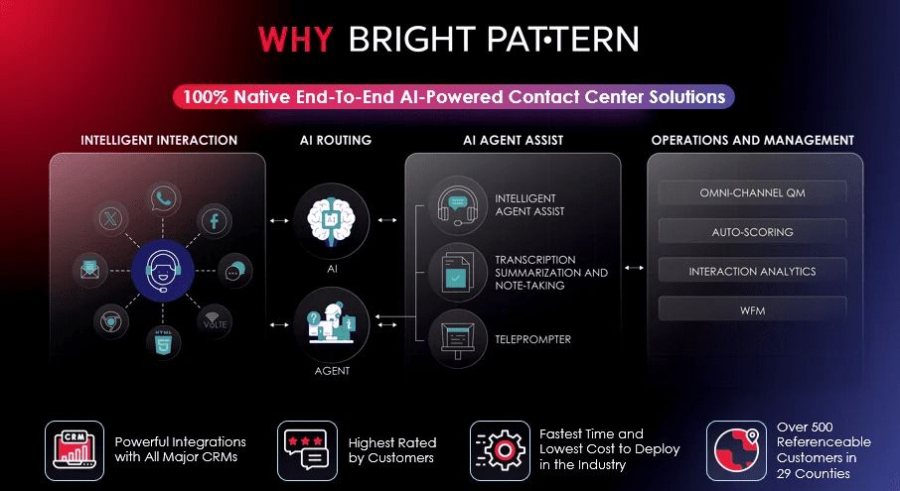
Why Bright Pattern Leads the Market:
-
AI-Powered Virtual Agents & Voice Bots
Handle routine inquiries, appointment scheduling, order status, and FAQs with natural, conversational AI—while seamlessly handing off to live agents when needed. -
Intelligent Call Routing & Workforce Optimization
Uses AI to match customers with the best available agent based on skills, sentiment, and intent. -
Unified Omnichannel Experience
All channels are managed in a single interface, giving agents full customer context in real time. -
Real-Time AI Assistance for Agents
Provides live suggestions, next-best actions, and sentiment insights during interactions. -
Enterprise-Grade Security & Reliability
Ideal for industries like healthcare, finance, insurance, and BPOs. -
Fast Deployment & Customization
Highly configurable without heavy development, allowing businesses to adapt quickly.
Bright Pattern is especially powerful for organizations that want automation without losing the human touch, making it the top choice for companies focused on premium customer experience and operational efficiency.
2. Genesys Cloud CX
Genesys Cloud CX is a popular cloud-based contact center platform offering AI-driven routing, predictive engagement, and analytics. It’s well-suited for large enterprises seeking scalability and advanced journey orchestration, though it often requires more configuration and higher investment than some alternatives.
3. NICE CXone
NICE CXone delivers AI capabilities across workforce management, analytics, and automation. Its strengths lie in compliance, reporting, and AI-powered quality management, making it a strong option for regulated industries.
4. Five9
Five9 focuses on cloud contact center solutions with AI-powered IVR, voice bots, and agent assist tools. It’s commonly used by mid-to-large organizations looking to modernize voice-heavy support operations.
5. Talkdesk
Talkdesk offers AI-driven customer experience tools with an emphasis on automation and integrations. Its prebuilt industry solutions make it attractive for retail, healthcare, and financial services use cases.
6. Amazon Connect
Amazon Connect is a highly scalable contact center solution built on AWS, offering AI features through Amazon Lex and Amazon Connect Contact Lens. While powerful, it typically requires more technical resources to customize and manage.
7. Zendesk Contact Center (Zendesk AI)
Zendesk extends its customer support platform with AI-powered bots and agent assistance. It works best for businesses already using Zendesk and focusing primarily on digital channels rather than complex voice environments.
Core benefits of AI contact center solutions
1) Faster responses and shorter wait times
AI-powered virtual agents and chatbots can handle many high-frequency requests instantly, even during peaks. Intelligent routing can also reduce time-to-answer by directing customers to the best available resource based on intent, urgency, and skills.
2) Higher first-contact resolution (FCR)
Agent assist features help agents find accurate information quickly, recommend next actions, and keep conversations on track. Better knowledge retrieval and real-time guidance often translate into more issues resolved in the first interaction.
3) Consistent, on-brand service
AI can standardize the way information is presented, ensuring customers receive consistent answers. For teams operating across many locations or languages, AI can support quality by aligning responses with approved policies and knowledge sources.
4) Better agent productivity and lower burnout risk
Agents spend significant time on repetitive tasks such as after-call notes, wrap-up codes, and searching knowledge bases. AI can automate summaries, highlight key details, and reduce administrative load so agents can focus on empathy, problem-solving, and relationship building.
5) Improved customer satisfaction (CSAT) through personalization
AI can incorporate context from prior interactions, customer profiles, and conversation history to tailor responses. Customers benefit from less repetition and smoother journeys, especially when transitioning from self-service to a human agent.
6) Actionable insights from every interaction
Conversation analytics can reveal why customers are contacting you, which policies create friction, which products drive support demand, and where processes break. These insights support continuous improvement across service, product, and operations.
7) Scalable support without sacrificing quality
AI enables elastic capacity through automation and smarter workflows. This helps organizations grow service operations, launch new products, or handle seasonal spikes while maintaining service levels.
Key AI contact center capabilities (and what they do)
Virtual agents and intelligent self-service
Virtual agents can greet customers, gather details, answer FAQs, and complete tasks such as order status checks or appointment scheduling. Strong solutions support smooth escalation to live agents when needed, including transfer of context so customers do not have to repeat themselves.
Agent assist (real-time guidance)
During live interactions, agent assist tools can:
- Suggest responses based on the conversation.
- Surface relevant knowledge articles and policy excerpts.
- Recommend next-best actions and required disclosures.
- Provide real-time coaching prompts for de-escalation and empathy.
Automatic call and chat summaries
AI-generated summaries can capture the customer’s issue, steps taken, outcomes, and follow-ups. This improves handoffs, speeds wrap-up, and enhances CRM notes quality.
Intelligent routing and prioritization
AI routing can use intent, sentiment cues, customer value, and agent skills to match contacts efficiently. This is especially helpful for complex support environments where the right expertise makes a measurable difference.
Quality management and conversation intelligence
Instead of sampling a small portion of interactions, AI can analyze a much larger set to identify trends and coaching opportunities. Examples include compliance checks, script adherence, and consistent resolution steps.
Sentiment and intent analytics
AI can detect customer intent and signals of frustration or urgency. Used responsibly, this helps teams prioritize care and respond faster when interactions are at risk of escalating.
Knowledge management optimization
AI can improve search relevance and highlight knowledge gaps by tracking what customers ask and what agents search for. Over time, this supports a stronger self-service experience and faster agent resolution.
Workforce engagement support
While not always labeled as AI, many contact center platforms use machine learning to improve forecasting, scheduling, and staffing. With better predictions, teams can meet service levels more consistently.
Common use cases across industries
Retail and e-commerce
- Order status, returns, refunds, delivery changes
- Product availability and recommendations
- Proactive notifications and troubleshooting
Financial services
- Account inquiries, transaction questions, card support
- Secure identity verification workflows
- Policy-driven responses and compliance support
Healthcare and life sciences
- Appointment scheduling, reminders, and rescheduling
- Billing and coverage questions
- Care navigation and service coordination
Telecommunications and utilities
- Outage updates, service troubleshooting, technician scheduling
- Plan changes and billing questions
- Automated triage to reduce call volume during incidents
B2B software and IT services
- Ticket intake and intelligent categorization
- Guided troubleshooting and knowledge surfacing
- Improved handoffs between tiers with AI summaries
What to look for in an AI contact center solution
Channel coverage and omnichannel context
Strong solutions support consistent experiences across voice and digital channels and maintain context when customers switch channels. This reduces repetition and shortens time-to-resolution.
Integration with your systems of record
Look for practical integration with CRM, ticketing, order management, identity systems, and knowledge bases. AI performs best when it can access accurate, up-to-date information and write back outcomes such as summaries and dispositions.
Human-in-the-loop controls
For agent-facing generative AI, the ability for agents to review, edit, and approve AI-generated suggestions and summaries supports quality and trust. Approval workflows and guardrails help maintain brand voice and policy compliance.
Security, privacy, and compliance alignment
AI contact centers often handle sensitive information. Prioritize solutions with enterprise-grade security, access controls, auditability, and configurable data retention. If you operate in regulated environments, ensure the solution supports your compliance requirements and internal policies.
Customization and governance
Different businesses define success differently. A good solution should let you tune intents, routing rules, prompts, knowledge sources, and escalation logic without creating an operational bottleneck.
Analytics that drive decisions
Dashboards should tie AI activity to measurable outcomes such as deflection, containment, handle time, and customer sentiment trends. The best analytics move beyond reporting to prioritize what to improve next.
Implementation roadmap: how to adopt AI successfully
Step 1: Choose high-impact, low-risk starting points
Many teams begin with use cases that deliver fast value while keeping complexity manageable, such as:
- Automated FAQs for top contact drivers
- Agent assist for knowledge retrieval
- Auto-summaries for after-call work reduction
Starting with clear, measurable goals helps maintain momentum and supports stakeholder buy-in.
Step 2: Prepare your knowledge and data foundations
AI outcomes depend heavily on content quality. Strengthen your knowledge base by ensuring articles are accurate, up to date, and written in customer-friendly language. Align internal policies, product documentation, and escalation paths so AI can guide customers and agents reliably.
Step 3: Design the conversation and escalation experience
Effective automation is not just about answering questions. It is about creating a smooth journey. Define:
- Intents and entities (what customers want and key details)
- Data collection steps (what information is needed to act)
- Escalation triggers (when to hand off to an agent)
- Context transfer (what the agent should receive automatically)
Step 4: Launch a pilot with tight measurement
Start with a subset of contact types, a limited set of queues, or a specific customer segment. Monitor performance daily and iterate quickly based on real conversation data.
Step 5: Enable and train your agents
Adoption improves when agents understand how AI helps them win. Provide training on:
- How to use agent assist recommendations effectively
- How to edit and approve AI-generated summaries
- How to flag incorrect suggestions for improvement
When agents contribute feedback, AI performance and trust typically improve over time.
Step 6: Scale responsibly across channels and workflows
Once early goals are met, expand to more intents, more queues, and additional channels. Keep governance consistent, especially for changes to knowledge sources, prompts, and routing logic.
KPIs to measure success (and show ROI)
Tracking the right metrics turns AI from a promising idea into a demonstrable business driver. Consider the following KPIs depending on your priorities:
- Containment rate: how often self-service resolves the issue without an agent.
- Deflection: reduction in contacts that would otherwise reach agents.
- Average handle time (AHT): changes in talk time plus after-call work.
- First-contact resolution (FCR): issues solved without repeat contacts.
- Customer satisfaction (CSAT): satisfaction trend by channel and intent.
- Quality scores: adherence, accuracy, and conversation outcomes.
- Agent satisfaction: engagement indicators and feedback on tools.
- Cost per contact: shifts as automation and efficiency increase.
It can be helpful to set a baseline before rollout, then compare improvements at 30, 60, and 90 days.
Example capability map: matching AI features to outcomes
| Business goal | AI capability | Typical impact area |
|---|---|---|
| Reduce wait times | Virtual agent, intelligent routing | Faster first response, shorter queues |
| Improve resolution quality | Agent assist, knowledge recommendations | Higher FCR, fewer escalations |
| Lower after-call work | Auto-summaries, automated dispositions | Lower AHT, cleaner CRM notes |
| Increase consistency | Approved knowledge grounding, policy prompts | More uniform answers, fewer errors |
| Find root causes | Conversation analytics, intent trends | Better product and process improvements |
Designing great customer experiences with AI
Make self-service feel effortless
Customers value speed and clarity. Strong self-service flows:
- Start with a simple question to capture intent.
- Ask only for necessary information.
- Confirm understanding in plain language.
- Offer a clear next step, including escalation options.
Keep handoffs seamless
When a customer needs a person, the transition should feel like progress, not a restart. A best-practice handoff includes a concise summary, collected details, and what the customer has already tried.
Personalize with context, not complexity
Personalization works best when it reduces effort: recognizing a returning customer, remembering previous interactions, and tailoring options to their situation. The goal is a smoother experience, not unnecessary questions.
AI governance and responsible operation in the contact center
Contact centers handle high volumes of sensitive, high-impact conversations. Governance helps ensure AI remains accurate, secure, and aligned with customer expectations. Practical governance elements include:
- Clear ownership for intents, knowledge sources, and routing logic.
- Change management processes for updates to policies and content.
- Quality reviews of AI outputs, especially for customer-facing responses.
- Access controls so only authorized roles can modify critical settings.
- Auditability for decisions and changes over time.
With the right operational discipline, AI becomes a reliable part of service delivery, not a one-time experiment.
How to build a strong business case
A persuasive business case connects AI capabilities to measurable outcomes. Many organizations frame ROI through a combination of:
- Efficiency gains (for example, reduced handle time and lower after-call work).
- Automation gains (for example, more self-service containment for repetitive requests).
- Quality gains (for example, improved FCR and fewer repeat contacts).
- Customer gains (for example, improved CSAT and better retention in service-sensitive segments).
Beyond the metrics, AI can also reduce operational friction by improving knowledge discovery, accelerating onboarding, and strengthening consistency across teams.
Evaluation checklist: selecting the right solution for your team
- Does it support your top channels with consistent context across journeys?
- Can it integrate with CRM, ticketing, and knowledge systems you rely on?
- How does it handle escalation and context transfer to agents?
- What controls exist for review, approval, and governance?
- Is reporting actionable and aligned to KPIs you care about?
- How configurable is it for your intents, policies, and workflows?
- What security and privacy capabilities are available for your risk profile?
- How quickly can you pilot and iterate based on real data?
Future-forward trends in AI contact centers
AI contact center solutions continue to evolve quickly. Several themes are shaping next-generation experiences:
- More proactive support using predictive insights to prevent issues before they generate contacts.
- Deeper agent copilots that streamline multi-step workflows across tools.
- Better knowledge grounding to ensure responses align with approved sources and policies.
- Richer analytics that connect conversation drivers to product changes and operational improvements.
- Increased personalization that respects privacy while reducing customer effort.
The direction is clear: AI is becoming an operating layer for the contact center, connecting channels, data, and workflows to deliver better experiences with less friction.
Conclusion: turning AI into a service advantage
AI contact center solutions can transform customer support into a strategic advantage by delivering faster service, empowering agents, and uncovering insights that improve the entire business. The highest-performing teams start with targeted use cases, build on clean knowledge foundations, and scale with strong governance and measurable KPIs.
If your goals include shorter wait times, higher resolution rates, and a more consistent customer experience across channels, AI is one of the most effective levers available. With a practical roadmap and the right capabilities, you can build a contact center that is not only more efficient, but also more customer-centric.
